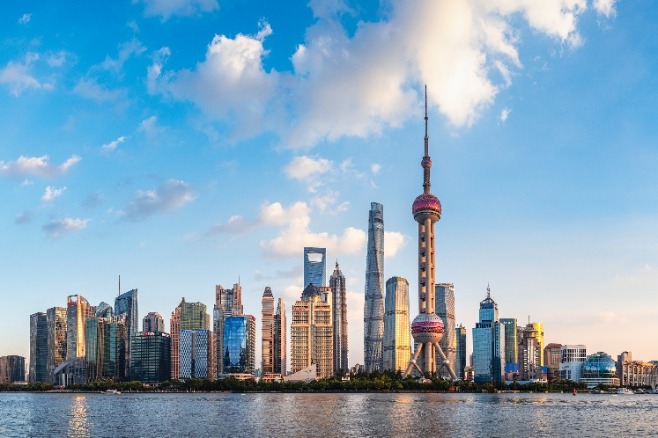
Shanghai will further consolidate its position as a global trade center by 2030, outlining a series of targets to enhance its appeal as a global consumption hub through high-standard opening-up, according to officials.
Amid new trends in digitalization, intelligence and green transformation, Shanghai will deepen reform to strengthen its position as a global trade hub and an international consumption center with global appeal, said Zhu Min, deputy secretary-general of the Shanghai Municipal Government, during a news conference recently held in the city.
"The guideline retains key indicators from the previous plan while responding to new trends and changes in global trade, setting out 10 targets covering trade, consumption and the city's functions as an international trade center," said Zhu, citing the guideline for Shanghai's development into an international trade center during the 15th Five-Year Plan (2026-30) period.
According to Zhu, Shanghai is the world's largest port city and has recorded more than 10 trillion yuan ($1.49 trillion) in port trade for five consecutive years.
The city is also home to more than 80,000 foreign-invested enterprises and over 70,000 foreign trade companies, and has more than 300 air routes connecting to destinations worldwide and over 350 international shipping routes.
"The elevation of Shanghai's position as an international trade center requires strong capabilities in global supply chain management, international resource allocation and services for global companies," Zhu noted.
Going forward, Shanghai will align with global trends toward smarter, greener and more specialized supply chain management. It will promote the development of a global supply chain management hub and encourage companies to strengthen their global presence, helping enhance the resilience and security of their supply and industrial chains.
Shanghai has long been the preferred destination for foreign investment and a favored location for multinational companies to establish their industrial and supply chains. It will continue to create new opportunities for foreign investment during the 15th Five-Year Plan period, said Zhou Lan, deputy director of the Shanghai Municipal Commission of Commerce.
"Shanghai has the largest concentration of foreign-invested company headquarters and foreign-funded research and development centers in China. To date, the city has officially recognized more than 1,100 regional headquarters of multinational companies and 670 foreign-funded R&D centers," said Zhu.
During the 15th Five-Year Plan period, Shanghai will better support the transformation and upgrading of foreign-funded enterprises, and help foreign enterprises integrate more effectively into China's huge market, Zhu said.
"Foreign companies are encouraged and given support to integrate their regional headquarters with multiple functions ranging from R&D, financial and capital management, and investment decision-making to supply chain management. The regional headquarters are welcome to upgrade into Asia-Pacific headquarters and global business unit headquarters," Zhou added.
More than 5,700 foreign-invested enterprises were established across the city annually during the 14th Five-Year Plan (2021-25) period, while 305 multinational corporations' regional headquarters and 155 foreign R&D centers were certified during the same period, underscoring Shanghai's position as the city with the largest number of MNC headquarters in the Chinese mainland, Zhou said.
In terms of consumption, the plan specifies key targets, including average annual growth in total retail sales of consumer goods, as well as targets for the debut economy and inbound consumption.
Shanghai will accelerate its development as a world-class consumption destination, Zhou said.
"Services account for an increasingly large share of consumer spending in Shanghai, and have become the main driver of consumption growth," Zhu said.
Shanghai's per capita GDP has surpassed $30,000, and services consumption has entered a period of rapid growth, which allows the city to explore ways to expand service consumption by improving supply.
"Last year, the exhibition 'On Top of the Pyramid: The Civilization of Ancient Egypt' alone brought about combined consumption of more than 35 billion yuan. And the indirect consumption of the F1 Chinese Grand Prix reached 6.91 billion yuan," Zhou said, citing the figures as examples.
Shanghai's annual trade in services has exceeded $250 billion, ranking first among peers nationwide.
wang_ying@chinadaily.com.cn
 京公网安备 11010502049590